

MiroFish
Predict anything with MiroFish's AI simulation chat. Turn questions into multi-agent scenarios and get structured prediction reports for better decisions.
AI AgentsAI ProductivityFree tierWebPublic0 Views
Screenshots
About this product
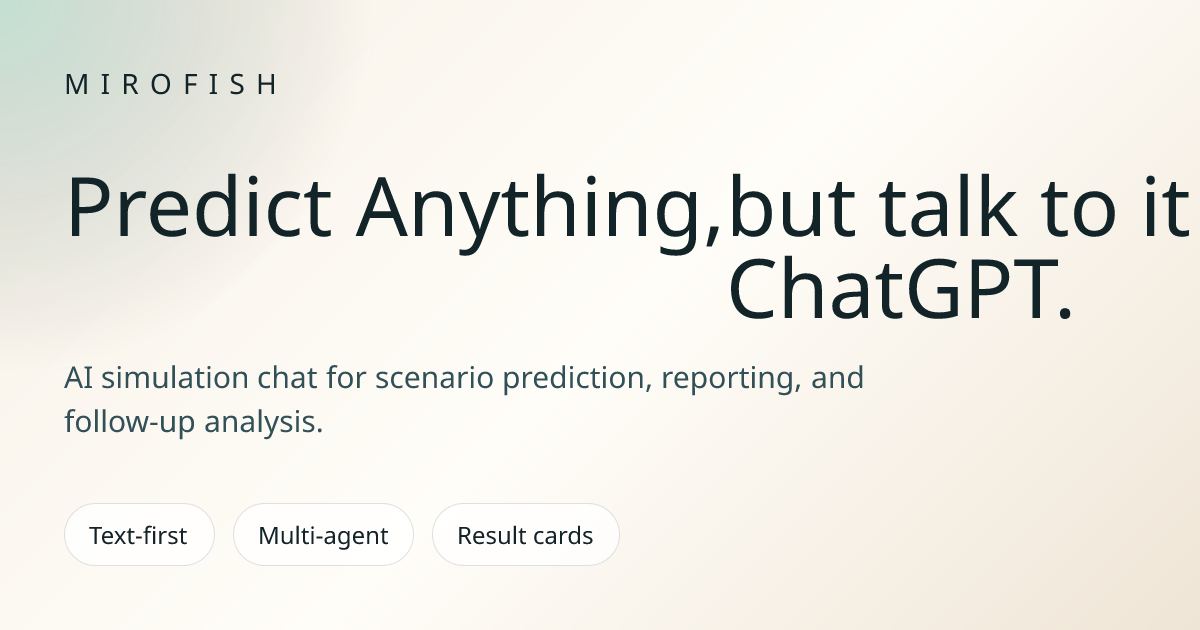
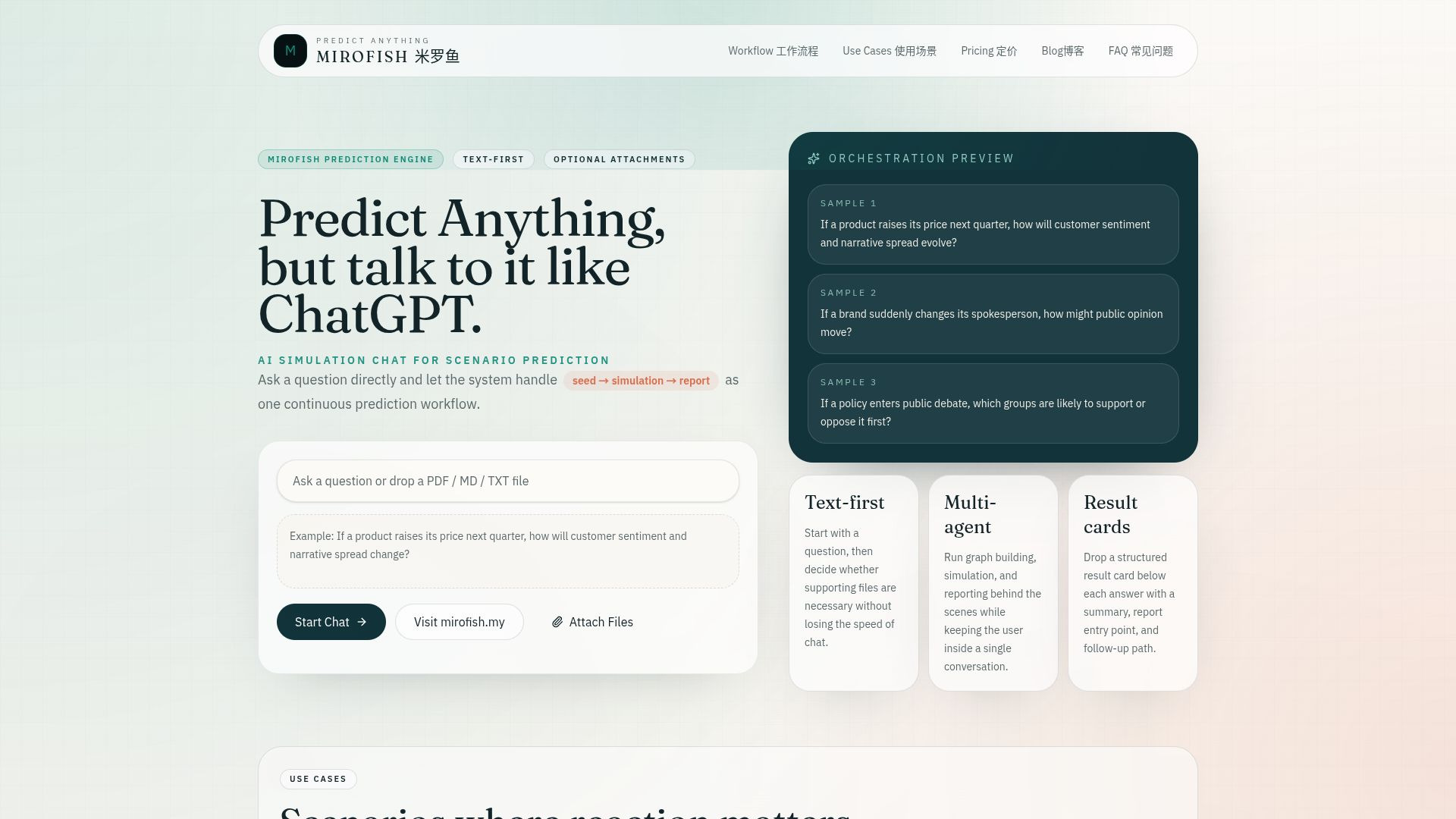
MiroFish is an AI-powered scenario simulation and prediction platform that reframes forecasting as a conversation. Instead of asking users to configure complex models or fill out structured forms, MiroFish invites them to simply type a question the way they would talk to ChatGPT — for example, "If a product raises its price next quarter, how will customer sentiment and narrative spread change?" — and then handles the rest of the pipeline automatically. Under the hood, the platform runs a multi-stage workflow that starts with seed material (a plain-language question, a strategy memo, a policy brief, a market note, or a story fragment), extracts actors, relationships, pressures, and factual anchors into a knowledge graph, and then spawns multiple AI personas that interact across short-form and threaded social surfaces over several simulation rounds. The emergent behavior from those agent interactions is condensed into a structured prediction report containing an executive summary, risk signals, narrative paths, turning points, confidence indicators, and suggested follow-up questions. MiroFish is positioned as exploratory decision support rather than a guaranteed forecast, making it most valuable for teams facing questions where human reaction loops matter more than a static answer. Its core use cases include campaign and launch narrative testing, pricing-change reaction modeling, policy stress tests and tabletop exercises, market narrative analysis, crisis response rehearsal, and creative continuation. Target audiences include product marketers, brand strategists, pricing and revenue teams, public affairs and policy analysts, market researchers, PR and communications professionals, founders, and strategy consultants who need to understand how different audience groups might amplify, resist, or reinterpret a message before committing real budget. Key features include a text-first chat interface with optional PDF, Markdown, and text file attachments as "reality seeds"; a multi-agent simulation engine with persona memory; an orchestration layer that builds graphs, runs simulations, and synthesizes reports behind the scenes so the user stays inside a single conversation; result cards delivered beneath each answer with a summary, a report entry point, and a follow-up path; and a deep-interaction mode that lets users keep asking questions against the generated world rather than stopping at one static answer. Content-wise, MiroFish pairs its product with practical playbooks — how to write a sharper prediction prompt by naming the decision, audience, trigger, and time horizon; how to use files as grounding seeds; and how to read a report like a rehearsal rather than a verdict. It also publishes a blog, a use-cases library, a comparison against single-shot chat answers and manual research, and a FAQ that deliberately sets expectations without overclaiming accuracy. In terms of user experience, the design is deliberately minimal and conversational: a text-first prompt box, sample prompts to lower the cold-start barrier, static report previews so visitors know what output looks like before signing up, and small directory badges that keep the focus on the product. Technically, MiroFish combines large language model agents, knowledge-graph construction, multi-round agent orchestration, social-surface simulation, and automated report synthesis into one continuous pipeline, with the main application experience living at mirofish.my. The result is a tool for rehearsing plausible futures quickly, cheaply, and iteratively — a way to pressure-test a narrative before it goes public and to ask which group would change the outcome if its incentive changed.
Similar products
 KoncileAutomate your procurement processes with Koncile’s advanced AI document extraction and control solutions designed for efficiency and accuracy.
 Pie Chart MakerCreate stunning pie charts in seconds using our intuitive Pie Chart Maker. Perfect for students and professionals!
 DiaflowTransform your business with Diaflow's no-code AI platforms, enabling seamless workflow automation and app development for enhanced productivity and growth.